
Storing an RV, boat, or large trailer on your property makes life easier - no storage lot fees, no driving across town to pick up your rig before a weekend trip. But parking a 10,000+ pound vehicle on grass or gravel creates ruts, mud, and damage that gets worse every season. A purpose-built concrete RV pad or boat pad keeps your equipment on a solid, level surface while protecting your yard and property value. Venture Concrete & Fencing builds heavy-duty RV and boat pads for homeowners in Slidell, Covington, Mandeville, Madisonville, Abita Springs, and Pearl River.
Why Concrete for RV & Boat Storage?
- Load capacity: A concrete pad must be sized for the loaded vehicle and concentrated loads at tires and supports. Thickness, reinforcement, soil support and drainage all affect performance; reinforcement does not eliminate cracking or settlement.
- Level surface: A level pad makes hitching and unhitching safer and easier. It also prevents your RV from leaning, which stresses the frame and causes interior damage over time.
- Clean storage: No mud splashing up on your boat hull or RV tires. No gravel dust coating your equipment. Concrete keeps everything clean and accessible.
- Property protection: Without a pad, heavy vehicles tear up your lawn, kill grass, and create drainage problems. A concrete pad contains the impact to a defined area.
- Property value: A dedicated RV or boat pad is a selling point for buyers who own recreational vehicles. It adds functional value that shows up at appraisal time.
Sizing Guide
Choosing the right pad size ensures you have enough room for your vehicle plus safe access around it:
Standard RV Pad
Most Class A and Class C motorhomes need a pad at least 12 feet wide by 45-50 feet long. Travel trailers and fifth-wheels typically require 12 by 35-40 feet. We add 2-3 feet of extra width on each side for stabilizer jacks and walk-around access.
Boat & Trailer Pad
A standard bass boat or center console on a single-axle trailer fits on a 10 by 25 foot pad. Larger boats on tandem-axle trailers need 12 by 30-35 feet. We size the pad to your specific rig and include space for tongue jack clearance at the front.
Combination Pad
Storing both an RV and a boat? We can pour a single larger pad or two separate pads with a connecting apron for easy maneuvering. We design the layout based on your property dimensions and how you access the storage area.
Thickness & Reinforcement
RV and boat pads need to be thicker and stronger than standard driveways due to the concentrated loads involved:
- Minimum thickness: 5 inches for most RV and boat pads (compared to 4 inches for a standard driveway)
- Heavy-duty option: 6 inches with rebar on 18-inch centers for Class A motorhomes, large fifth-wheels, or multi-vehicle storage
- Reinforcement: Steel rebar grid throughout the slab, not just wire mesh. This is critical for handling the point loads from stabilizer jacks, trailer tongue jacks, and wheel positions
- Subbase: 6 inches of compacted gravel minimum, with additional depth in areas with soft or organic soils
Drainage Planning
A large concrete pad changes how water flows across your property. We plan drainage carefully:
- The pad is sloped 1-2% to direct rainwater toward approved drainage points
- Perimeter grading directs water away from your home's foundation and neighboring properties
- For pads in low-lying areas, we can integrate a French drain or channel drain along one edge
- Expansion joints between the pad and any existing concrete (driveway, sidewalk) prevent water seepage at connection points
Installation Process
- Site consultation: We visit your property, measure your vehicle, identify the best pad location, and discuss access routes. We also check for underground utilities and setback requirements.
- Excavation: The pad area is excavated 10-12 inches below finished grade to accommodate the gravel base and concrete thickness.
- Gravel base: Crushed limestone is spread in lifts and compacted to create a firm, draining foundation.
- Forming and reinforcement: Heavy-duty forms are set to the correct dimensions. Rebar is tied on a grid pattern and elevated on chairs for proper placement within the slab.
- Concrete pour: High-strength concrete (4,000+ PSI) is placed, vibrated to eliminate voids, and finished with a broom texture for traction.
- Curing: The slab cures for a minimum of 7 days before any vehicle is placed on it. Full strength at 28 days.
What Affects an RV or Boat Pad Quote?
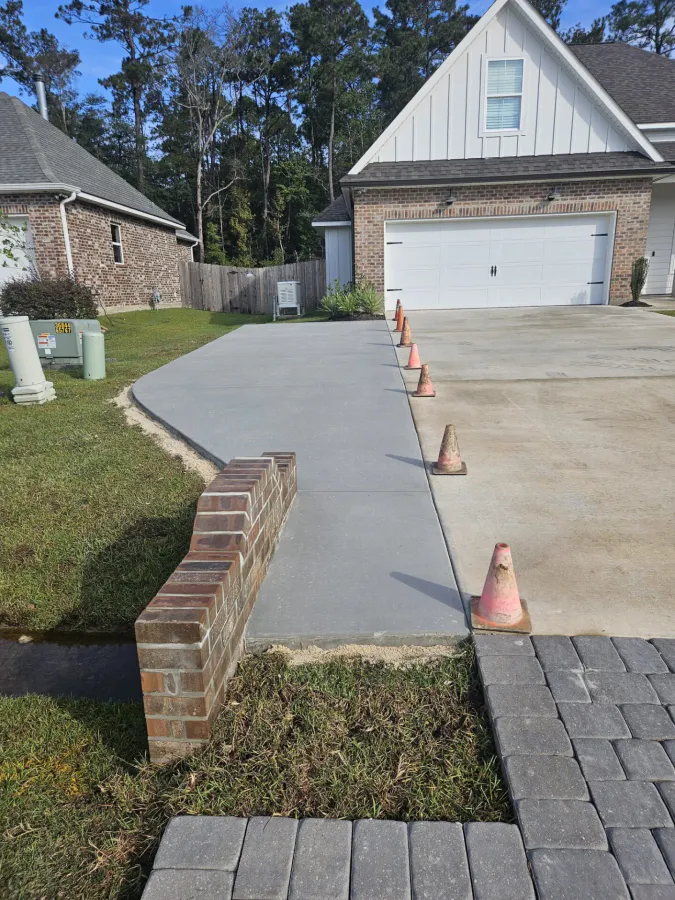
The footprint, vehicle load, ground preparation, and access to the pour all affect the scope. Removal of existing concrete, a connection to your driveway, and drainage work can also change the quote.
Plan Your RV or Boat Parking Pad
Tell us your city, what you plan to park, and where the pad would go. Vehicle or trailer dimensions and weight help us discuss the project. You can send those details after the first conversation.
Serving Slidell, Covington, Mandeville, Madisonville, and Pearl River.
Connecting to an existing driveway? See driveway extensions.
From our concrete project gallery
Park Your Rig on Solid Ground
Stop dealing with ruts, mud, and sinking gravel. Get a free quote for a concrete RV or boat pad built to handle the load.